
Abstract:
This study examines the strategic implications of disruptions to maritime navigation in the Arabian Gulf for the Indo-Pacific region, with particular focus on the crisis resulting from the closure of the Strait of Hormuz.
The study proceeds from the hypothesis that the greater the disruption to maritime navigation in the Arabian Gulf, the more significant its strategic implications for the Indo-Pacific. Drawing on Regional Security Complex Theory (RSCT), it analyses how instability originating in the Gulf spreads across regions through economic, energy, and security linkages.
The study finds that disruptions to navigation through the Strait of Hormuz have generated consequences extending well beyond the immediate geographic theatre, undermining economic stability in the Indo-Pacific through heightened energy insecurity and disruptions to regional supply chains.
The continuation of military operations in the Arabian Gulf has also affected the Indo-Pacific balance of power. The redeployment of certain US military capabilities, coupled with the attrition of others, has altered regional balance-of-power calculations and affected the credibility of US deterrence in the Indo-Pacific.
Conversely, the crisis has given China an opportunity to observe US military performance, identify potential vulnerabilities, and draw operational lessons on asymmetric warfare and anti-access/area-denial (A2/AD) strategies.
The findings support the study's central hypothesis, demonstrating that the security of the Strait of Hormuz is directly linked to that of the Strait of Malacca and that disruptions to maritime navigation in the Arabian Gulf have become a significant factor shaping economic and security stability in the Indo-Pacific.
Finally, the study offers recommendations for the Yemeni government to capitalise on the strategic and economic opportunities arising from the crisis. These centre on leveraging Yemen's geographical position, including its extensive coastline and islands, to strengthen the country's role as a regional and international corridor and hub for energy flows and strategic raw materials, in ways that advance both Yemeni and wider global interests.
The Arabian Gulf is experiencing an unprecedented period of instability as a result of ongoing military operations between Iran and the United States, which have led to the closure of the Strait of Hormuz and severe disruption to maritime navigation. These disruptions have directly affected commercial shipping, particularly oil tanker traffic.
Although the crisis is geographically centred in the Middle East, its direct and indirect repercussions extend well beyond the region to the Indo-Pacific, one of the world's most economically and strategically significant regions.
The Indo-Pacific's strategic importance is closely tied to global trade and energy flows. More than 55% of global seaborne container trade and approximately 70% of global seaborne energy supplies pass through the region.[1] The Indo-Pacific also imports most of its oil from the Middle East, much of which transits the Strait of Hormuz.[2]
By mid-2025, approximately 89% of the oil exports transiting the Strait of Hormuz were destined for the Indo-Pacific, representing the overwhelming majority of oil exports passing through the strait.[3] This further underscores the strategic importance of the maritime routes linking the Strait of Hormuz to the Strait of Malacca. Against this backdrop, any disruption to oil flows from the Strait of Hormuz towards the Indo-Pacific could generate severe cascading effects across the global economy.
The Indo-Pacific is also a key arena of strategic competition between the United States and China. Accordingly, any redeployment of US forces from the Indo-Pacific to conduct operations in or around the Arabian Gulf could significantly alter the regional balance of power. Such a shift could heighten threat perceptions among Indo-Pacific states as the regional balance changes, further intensifying tensions and instability across the region.
Moreover, the security of the Arab region is closely intertwined with developments in the Indo-Pacific, whose geographic scope, under broader conceptions of the region, encompasses several Arab states, including Oman, Yemen and Somalia. The inclusion of these three states within the Indo-Pacific strategic space reinforces the interdependence between the two regions, with developments in either carrying potential implications for the other.
Given this clear interdependence between security in the Arabian Gulf and the Indo-Pacific, the study seeks to answer the following central question:
How does disruption to maritime navigation in the Arabian Gulf affect stability in the Indo-Pacific?
To answer this question, the study advances the following central hypothesis: the greater the disruption to maritime navigation in the Arabian Gulf, the more significant the strategic implications for the Indo-Pacific. This central hypothesis gives rise to two sub-hypotheses:
- The longer disruptions to maritime navigation in the Arabian Gulf persist, the more rapidly Indo-Pacific states will move towards the "securitisation" of supply chains, treating their security as an existential concern.
- The greater the redeployment of US forces from the Indo-Pacific towards the Arabian Gulf, the greater the disruption to the balance of power in the Indo-Pacific.
Accordingly, this research paper is organised into five main sections. The first establishes the study's theoretical framework, employing Regional Security Complex Theory (RSCT) as the analytical lens through which the subject is examined. The second defines the Indo-Pacific and assesses its strategic significance, while the third provides an overview of disruptions to maritime navigation in the Arabian Gulf.
The fourth section analyses the implications of these maritime disruptions for the Indo-Pacific, focusing on their effects on supply chains and the regional balance of power. The fifth and final section presents recommendations for the Yemeni government.
First: Theoretical Framework:
This study employs Regional Security Complex Theory (RSCT) to analyse the relationship between disruptions to maritime navigation in the Arabian Gulf and their strategic implications for the Indo-Pacific.
More specifically, the study draws on the concept of "transregional security interdependence", which proceeds from the premise that the international system comprises multiple regional subsystems that are open to and interconnected with one another. Sustained interaction among these subsystems renders the boundaries separating regional security systems increasingly fluid.
Regional security complexes are characterised by enduring patterns of interaction and mutual security interdependence. They emerge from the interplay between the anarchic structure of the international system and its implications for the balance of power, on the one hand, and the pressures arising from geographical proximity, on the other.
The closer the geographical proximity between regional systems, the more intense their security interactions tend to become, as geographic contiguity facilitates the transmission of threats across regional boundaries. Regional systems are therefore interconnected through patterns of reciprocal interaction, although the intensity of these linkages varies according to several factors. Foremost among them is geographical proximity, which plays a significant role in determining the scale and intensity of security interaction. [4]
Against this backdrop, the theoretical framework helps explain how geographical proximity and the intensity of interaction between the Arabian Gulf and the Indo-Pacific have integrated the Gulf security complex into the Indo-Pacific's broader security dynamics.
The theory further explains how freedom of navigation in the Arabian Gulf has evolved from a predominantly commercial concern into a security issue with direct implications for the Indo-Pacific. It also provides an analytical basis for understanding the strategic interdependence between the Straits of Hormuz and Malacca as two critical maritime chokepoints.
Map (1)
Chokepoints in the Western Indo-Pacific

Source: Darshana M. Baruah, Nitya Labh, and Jessica Greely, "Mapping the Indian Ocean Region," Carnegie Endowment for International Peace, June 15, 2023, accessed August 7, 2026, https://carnegieendowment.org/research/2023/06/mapping-the-indian-ocean-region
Second: The Indo-Pacific Region:
The way states perceive their surrounding geopolitical environment shapes both their understanding of security threats and their assessment of the opportunities and interests at stake.
Regional systems are not merely fixed geographical spaces. They are also evolving conceptual constructs shaped by changing political and economic conditions, historical developments, and how states perceive and interpret these transformations. The Indo-Pacific is a prime example. [5]
The Indo-Pacific concept is a regional framework that brings together the Indian and Pacific Oceans within a single strategic space. It emerged as an alternative to the Asia-Pacific concept, which had dominated regional thinking towards the end of the twentieth century. [6]
The first explicit articulation of the Indo-Pacific as a single regional system dates to 2005, when the concept appeared in Australian academic studies in the context of regional developments following the ASEAN Summit of November 2004 and the East Asia Summit (EAS) held in 2005.
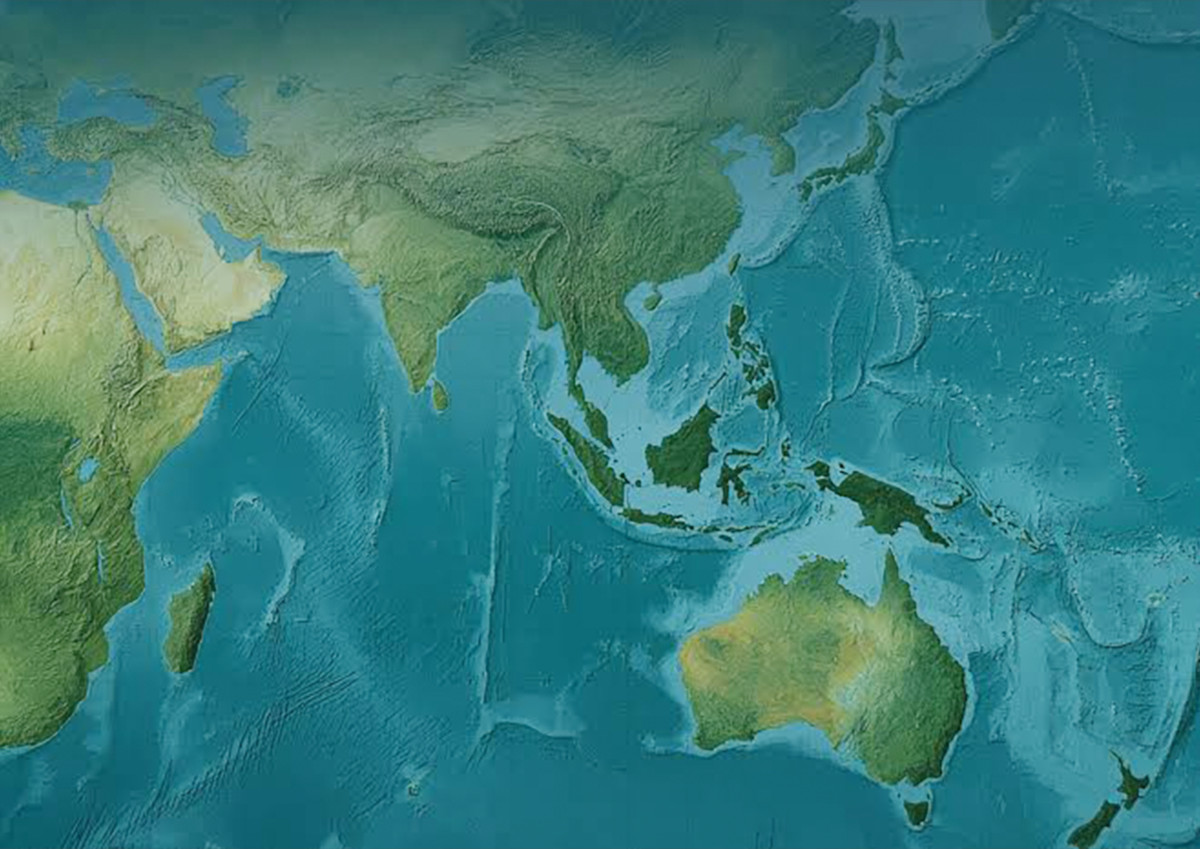
Geographically, the Indo-Pacific extends from the eastern Indian Ocean to the Pacific Ocean, connected through Southeast Asia and encompassing India, North Asia, and the United States. Interactions within this regional system are therefore predominantly maritime. Map 2 shows the region's geographical boundaries. [7]
Geographically, the Indo-Pacific extends from the eastern Indian Ocean to the Pacific Ocean, linked through Southeast Asia and encompassing India, North Asia, and the United States. [8] Interactions within this regional system are therefore predominantly maritime in nature.[9] Map (2) illustrates the geographical boundaries of this regional system.
Map (2)
Boundaries of the Indo-Pacific Region[10]

The Indo-Pacific is one of the world’s most strategically significant regions, a status underpinned by political, security, and economic factors. Politically and strategically, the Indo-Pacific is a principal arena of interaction among the major powers, particularly the United States and China. It is also a major arena of intense competition between them, a dynamic widely regarded as a key factor that could reshape the broader contours of the global order. [11]
Moreover, the region is home to several middle powers, including Australia, Japan, South Korea, Singapore, and Indonesia, alongside India’s rapidly growing power, which has increasingly come to be viewed as a rising global power. In other words, the Indo-Pacific has become densely populated by interactions among major and middle powers. [12]
The region also encompasses two important geographical areas. The first is the Southwest Pacific, which includes the island states of the western Pacific, as well as the United States, China, and Japan. Beyond being an arena of intensifying competition between the United States and China, this area holds particular strategic significance for both powers. The United States regards it as its strategic backyard, as well as the region in which it was attacked by Japan during the Second World War, while China views it as a natural extension of its economic and military interests.
The second is the Indian Ocean, with India at its core. This constitutes the principal geographical addition introduced by the Indo-Pacific concept, which superseded the Asia-Pacific framework. As a result, the new regional system has become a dynamic arena of interaction among global powers. [13]
Economically, the Indo-Pacific includes some of the world’s busiest and most strategically important trade routes and has surpassed the Atlantic in economic significance. [14]
The region encompasses several strategically important areas, including the Bay of Bengal and the Strait of Malacca. More than 55% of seaborne container trade and approximately 70% of global seaborne energy supplies pass through the Indo-Pacific.[15] The region also accounts for nearly 47% of global energy consumption,[16] most of which comes from the Middle East.[17]
Moreover, 14 Indo-Pacific countries collectively account for approximately 40% of global GDP,[18] underscoring the region’s considerable economic weight and pivotal role in the global economy.
Third: The Strait of Hormuz and Disruptions to Maritime Navigation
The Strait of Hormuz is one of the world’s most important maritime chokepoints, through which a wide range of commodities integral to global supply chains pass, foremost among them energy products and agricultural fertilisers.
However, the Strait has witnessed a series of escalating security incidents, culminating in its closure and attacks on commercial vessels transiting through it. These developments have disrupted and impeded global supply chains. Against this backdrop, it is useful to trace the sequence of events that led to these disruptions and the repercussions that followed.
In late 2025, Iran witnessed widespread demonstrations and popular protests over the deteriorating economic situation and the accompanying collapse of the national currency. The protests, initially driven by economic grievances, quickly evolved into demands for broader political change and the abandonment of the Velayat-e Faqih system. [19]
In early January 2026, as the protests expanded, Iran shut down internet access and launched a large-scale crackdown. Numerous international reports subsequently stated that Iran’s Islamic Revolutionary Guard Corps (IRGC) and Basij forces had carried out a violent crackdown that left thousands dead. [20]
In the wake of the violence, the US president stated on 13 January 2026 that American assistance was on its way to support the protesters and urged the Iranian people to continue their protests. [21]
The Iranian government responded by portraying the protests as a war waged by the United States and Israel, warning that it would respond forcefully to any attempt to undermine the security of the regime and that any ensuing conflict would engulf the entire Middle East. [22]
In early February, Iran and the United States held a round of negotiations over Iran’s nuclear programme. On 28 February, the United States and Israel launched a surprise attack on Iran, killing Supreme Leader Ali Khamenei, along with several senior figures in the IRGC, the Guardian Council, and other sovereign state institutions. [23]
In the wake of the attack, Iran announced the closure of the Strait of Hormuz on 2 March and began targeting vessels attempting to transit the waterway, thereby disrupting oil flows equivalent to approximately 20% of global daily consumption. [24]
Consequently, the closure had far-reaching repercussions for the global economy. Its effects extended beyond disrupting oil supplies equivalent to a quarter of global demand to include fertiliser supplies, which are critical to global food security. For example, approximately 35% of global urea flows, 25% of ammonia fertiliser flows, nearly 20% of phosphate fertiliser flows, and around 45% of global sulphur fertiliser exports transit the Strait.
Such disruption could place significant pressure on global fertiliser supply chains, potentially driving up agricultural production costs and food prices and increasing the risk of a global food crisis whose effects could persist for several years. [25]
The closure also brought a significant volume of shipping to a standstill, leaving thousands of seafarers stranded in the region. At the outset of the crisis, the number of stranded seafarers was estimated at around 20,000, before subsequently falling to approximately 6,000 aboard nearly 500 vessels as of 9 August 2026, according to the latest available reports.[26] This, in turn, disrupted approximately 8% of global seaborne trade transiting the Strait.[27]
Against this backdrop, Iran recognised that an asymmetric deterrence strategy based on the use of a limited number of missiles, drones, and naval mines to target vessels transiting the Strait of Hormuz could inflict severe damage on the global economy, effectively holding it hostage as a bargaining chip in negotiations with the United States and other regional states bordering the Strait, with the aim of imposing its terms. [28]
The following section examines the implications of Iran’s use of this strategy for the Indo-Pacific.
Fourth: Maritime Disruptions and the Indo-Pacific
The Arabian Gulf and Indo-Pacific security complexes are characterised by enduring patterns of economic interaction and mutual security interdependence.
These dense patterns of interaction and interdependence are a natural consequence of the economic interconnectedness between the Strait of Hormuz and the Strait of Malacca. The two straits form part of a single maritime route that closely connects the supply chains of the two regions, meaning that disruption in one reverberates through the other.
Beyond their economic interdependence, the two regions' security complexes are also connected through the balance-of-power dynamics between China and the United States. This section therefore examines how the closure of the Strait of Hormuz affects supply chains and the balance of power in the Indo-Pacific.
- Supply Chain Disruptions:
The closure of the Strait of Hormuz has inflicted severe damage on the Indo-Pacific economy, most notably by disrupting supply chains. Numerous supply chains moving to and from the Indo-Pacific have been significantly affected, with the most prominent including the following:
Energy Supply Chain Disruptions:
The Indo-Pacific is heavily dependent on energy exports transiting the Strait of Hormuz. In 2025, approximately 89% of the oil exports passing through the Strait were destined for the Indo-Pacific. [29]
Against this backdrop, approximately 93% of Japan’s oil imports transit the Strait of Hormuz, compared with around 70% of South Korea’s, 58% of Taiwan’s, and 50% of China's.[30] India, meanwhile, imports approximately 40% of its oil through the Strait.[31]
As for liquefied natural gas (LNG), Qatar and the United Arab Emirates together account for approximately 20% of global LNG exports, all of which transit the Strait of Hormuz. Approximately 90% of the natural gas exported through the Strait is destined for the Indo-Pacific,[32] accounting for nearly 27% of the region’s natural gas imports.[33]
For example, approximately 33% of China’s LNG imports transit the Strait,[34] compared with around 61% of India’s[35] and 14.9% of South Korea’s.[36]
Following the closure of the Strait of Hormuz, energy imports into the Indo-Pacific declined significantly. China lost approximately 3.6 million barrels per day (bpd) of seaborne oil imports, while Japan lost around 1.9 million bpd, South Korea 1 million bpd, and India 760,000 bpd.[37] As for LNG imports, the region’s total imports declined by 5 billion cubic metres in the first half of 2026 compared with the same period in 2025. China’s LNG imports, for example, fell by 12% year on year. [38]
This marked decline in energy imports drove up energy prices across the Indo-Pacific. Crude oil prices, for example, fluctuated between $100 and $120 per barrel in May 2026[39] and between $92 and $105 per barrel in July 2026. [40]
Prices of refined petroleum products also rose as refinery operations were disrupted, with jet fuel prices tripling from their pre-closure levels.[41] In addition, gas prices in the Indo-Pacific rose by 45% in the second quarter of 2026, reaching $17.5 per million British thermal units (MMBtu), the highest quarterly average since 2022. [42]
From another perspective, China and other countries in the region have continued to draw down their strategic oil reserves.[43] This raises the prospect of reaching a critical point at which the global energy system loses its capacity to absorb further shocks, potentially pushing Indo-Pacific energy markets and the global economy into a phase of forced demand destruction. This, in turn, could paralyse global supply chains across a broad range of goods as industrial production is disrupted. [44]
On the other hand, disruptions in energy markets have also affected domestic conditions across the Indo-Pacific. Some states have increased their reliance on coal-fired power plants. In contrast, others have introduced direct government subsidies to mitigate the impact of rising domestic prices for refined petroleum products on everyday life.
Several countries in the region also urged citizens to conserve electricity and use public transport, reduced official working days, and imposed limits on how much household cooking gas consumers could purchase. [45]
In addition, several countries in the region, including India, Pakistan, Nepal, and Vietnam, witnessed domestic protests over rising prices for refined petroleum products and the resulting economic pressures. Approximately 1,200 protests linked to these repercussions were recorded, threatening domestic stability across the Indo-Pacific. [46]
Disruptions to Strategic Raw Material Supply Chains:
The closure of the Strait of Hormuz also disrupted supply chains for strategic raw materials used to process and extract rare minerals, which play a pivotal role in manufacturing lithium batteries in the Indo-Pacific. China, meanwhile, accounts for more than 80% of global lithium battery production[47] and 90% of total global exports of processed rare-earth minerals. [48]
This impact is evident in the Strait of Hormuz’s critical role in sulphur exports, with nearly half of global seaborne sulphur trade transiting the Strait. Sulphur is a key input in rare-mineral processing, serving as the principal feedstock for sulphuric acid, which is essential for processing a range of minerals, including copper, lithium, cobalt, and nickel.
Accordingly, the closure of the Strait had a severe adverse impact on sulphur prices, which in turn drove up the cost of processed rare-earth minerals in China. As sulphuric acid became the most expensive input in rare-earth mineral processing, technology products reliant on these minerals consequently saw substantial price increases.[49] In addition, the closure of the Strait of Hormuz affected helium supply chains, with Qatar a major exporter of the gas. [50]
Helium is a critical input in semiconductor manufacturing, which underpins a range of sensitive technologies, including processors and electronic chips, most of which are manufactured in Taiwan and China. Both countries depend heavily on helium supplies from Qatar. Moreover, helium cannot be stored for extended periods, making it difficult to maintain strategic reserves.
Consequently, the semiconductor industry is highly sensitive to fluctuations in helium prices transported through the Strait of Hormuz. Helium prices have risen by 100% since the Strait closed, amid tightening global supplies. This could ultimately halt semiconductor production in both Taiwan and China, potentially triggering a collapse of the global technology sector. [51]
In addition to driving up semiconductor production costs, the closure of the Strait also raised plastics manufacturing costs, which rely heavily on the petrochemical industry. This is particularly significant for polyethylene, around 43%[52] of whose global exports originate in the Middle East, with approximately 84% of those exports transiting the Strait of Hormuz. [53]
In other words, approximately 36% of global polyethylene exports transit the Strait of Hormuz. Polyethylene is an essential raw material for plastics manufacturing and is used in a vast range of products, from children’s toys to computer and smartphone casings and vehicle components.
The closure of the Strait contributed to a roughly 37%[54] increase in polyethylene prices, prompting numerous petrochemical plants in China, India, Malaysia, Japan, and elsewhere in the Indo-Pacific to reduce production of industrial materials used in plastics manufacturing. [55]
Taken together, the repercussions of the closure of the Strait of Hormuz, including shortages of energy supplies and strategic raw materials essential to industrial production, disruptions to global supply chains, rising maritime freight costs, and other economic effects, have ultimately driven up the prices of manufactured goods produced in the Indo-Pacific, one of the world’s most important industrial hubs. This could push the global economy towards stagflation, with rising prices accompanied by declining demand for imports from the Indo-Pacific. [56]
- Impact on the Balance of Power:
Military operations in the Strait of Hormuz have extended beyond supply chains and economic conditions in the Indo-Pacific to affect the regional balance of power. This section examines how the escalation of the Hormuz crisis has altered Indo-Pacific security dynamics.
Depletion of Capabilities and Allied Apprehension:
Ongoing military operations in the Strait of Hormuz have depleted some US military capabilities allocated to the Indo-Pacific and raised doubts among US allies in the region about Washington’s ability to maintain the regional balance of power and preserve the status quo.
Several indicators suggest that Washington’s continued involvement in military operations in the Strait of Hormuz has come at the expense of US military readiness to respond to any Chinese escalation in the Indo-Pacific. One of the clearest indicators is the United States’ redeployment of one-third of its naval fleet towards the Strait of Hormuz,[57] including several vessels previously stationed in the Indo-Pacific.
In early January, the United States redeployed several warships from the Indo-Pacific theatre to the Strait of Hormuz theatre of operations. These included the aircraft carrier USS Abraham Lincoln and its carrier strike group, comprising the destroyers USS Frank E. Petersen Jr., USS Spruance, and USS Michael Murphy. By contrast, the United States retained only one aircraft carrier in the Indo-Pacific theatre, leaving the USS George Washington as the sole US aircraft carrier operating in the region. [58]
By early August, the United States had redeployed the USS George Washington and its carrier strike group, leaving the Indo-Pacific and the operational theatres of the East and South China Seas without aircraft-carrier coverage and creating what military literature calls a “carrier gap.”
Although temporary, this carrier gap has raised concerns among US allies and partners in the region, including Japan, South Korea, and Taiwan, while strengthening China’s military position.[59] It also risks making the United States appear overstretched and unable to fully uphold its commitment to the “pivot to Asia” strategy adopted in 2011 to prevent Chinese dominance of the region.[60]
Beyond the carrier gap created by redeploying one-third of the US naval fleet toward the Strait of Hormuz, the US Navy has faced additional pressures, most notably increased operational demands and attrition among naval forces deployed in and around the Strait. For example, the USS Gerald R. Ford experienced several maintenance problems, including a major fire in its main laundry facility. [61]
The USS Abraham Lincoln has likewise faced several logistical challenges, most notably shortages of food and ammunition, as well as crew fatigue after more than 260 days at sea without adequate rest. These conditions have adversely affected the operational readiness of the carrier’s 5,000-strong crew. [62]
Accordingly, the repositioning of US naval forces and the resulting depletion of their capabilities have raised concerns among US allies. In this context, Japan’s former defence minister said the redeployment and shifting posture of US naval forces were contributing to the expansion of Chinese influence, destabilising the Indo-Pacific balance of power, and increasing the likelihood of military tensions that could disrupt maritime navigation across the region. [63]
Beyond the adverse impact on naval assets, the strain has also extended to US stocks of interceptor and precision-guided missiles. Concerning interceptor missiles, the United States has significantly depleted its inventories, with some unofficial reports suggesting that more than 50% of its stockpiles have been expended. Moreover, several advanced radar systems used to guide interceptor missiles sustained damage that rendered them inoperable, and replenishing these missile and radar systems could take three to four years. [64]
The United States also withdrew several interceptor missile batteries from South Korea to meet growing requirements to counter Iranian missile attacks,[65] raising concerns in South Korea and among other US allies in the region about Washington’s ability to maintain the balance of deterrence in the Indo-Pacific.[66]
As for long-range precision-guided missiles, the United States expended a quarter of its stockpile in strikes against Iranian targets, limiting its capacity to conduct long-range operations in the Indo-Pacific in the event of a future conflict with China. [67]
To stem the depletion of these missile stockpiles, the United States delayed deliveries of missiles already contracted for by its partners in the Indo-Pacific. For example, the United States postponed the delivery of 400 precision-guided missiles to Japan by four years; deliveries had originally been scheduled to begin in 2026. [68]
In sum, regardless of the actual number of missiles and naval assets available to the US military, the mere perception among China and other regional states that US capabilities have been depleted by its operations in the Strait of Hormuz may be sufficient to undermine the balance of deterrence in the Indo-Pacific. After all, deterrence is a psychological process before it is a material one.
China’s Interest
At the outset, although China is among the countries most severely affected economically by the closure of the Strait of Hormuz, it may nevertheless emerge as the principal beneficiary of continued military operations in the Strait. The depletion of US capabilities would, in turn, increase China’s prospects of consolidating its dominance in the Indo-Pacific. Accordingly, China is seeking to strengthen its military and strategic position through several means.
One of the most important of these approaches is China’s close study and analysis of US military performance, including its response speed, the sophistication of its capabilities, and its operational vulnerabilities.
This opportunity is reminiscent of the one China had to study US military performance during the 1991 Gulf War, which demonstrated to Beijing the critical importance of precision-guided weapons in shaping the course of military operations. It prompted China to modernise and upgrade its armed forces to keep pace with advances in US military capabilities as much as possible. [69]
As for the current Iran–US war, it has provided China with a valuable opportunity to study and assess how the United States conducts warfare, including the time required for US forces to replenish their stocks of precision-guided and interceptor missiles, maintenance schedules, the time needed to mobilise military forces, and the speed at which they can be deployed.
In other words, military operations in the Strait of Hormuz have enabled China to identify and analyse vulnerabilities that it could exploit in the future to confront US forces while minimising its own losses, should a military confrontation between the two powers erupt over Taiwan. [70]
The war has also provided China with an opportunity to study Iran’s strategy for confronting the United States, based on asymmetric warfare and anti-access/area-denial (A2/AD) strategies. These approaches rely on relatively inexpensive weapons, including naval mines, drone swarms, and low-cost ballistic missiles, to disrupt maritime navigation and deplete stocks of costly interceptor missiles that are difficult to replenish rapidly once expended.[71]
By employing coastal radar systems, unmanned aerial and maritime systems, fast attack craft, and naval mines, Iran has constrained the United States’ ability to reopen the Strait of Hormuz while imposing substantial costs on US military operations.
Accordingly, these tactical realities have given China a valuable opportunity to further develop its anti-access/area-denial (A2/AD) strategy for application in the Indo-Pacific, potentially giving it a future advantage in any military conflict that may erupt in the region. [72]
Moreover, China is seeking, to the greatest extent possible, to prolong the war, recognising that every missile the United States fires at Iran is a missile that could otherwise have been used against China, and that every US aircraft shot down or vessel disabled represents a military asset that could otherwise have been deployed against it in the future.
Accordingly, China sees it as in its interest to indirectly prolong the war by providing intelligence and satellite imagery showing the positions of US ships and aircraft in the region through private Chinese companies linked to the Chinese military. [73]
China also supplied Iran during the war with a range of dual-use chemicals used in the production of missile propellants, including sodium perchlorate.[74] China has also supplied Iran with a range of defensive systems, including air-defence missiles. Most recently, it provided Iran with approximately 400 shoulder-launched air-defence missile systems. [75]
In return for this cooperation, China has secured several arrangements facilitating the passage of its vessels through the Strait of Hormuz. Through its military assistance, China is therefore seeking to secure economic and military advantages, thereby mitigating some of the economic losses imposed on the Chinese economy by the closure of the Strait. [76]
Conclusion:
This study concludes that the disruption of maritime navigation in the Arabian Gulf resulting from the closure of the Strait of Hormuz cannot be viewed merely as a security or economic crisis confined to the Gulf region. Rather, it constitutes a cross-regional strategic variable whose effects extend directly and indirectly to the Indo-Pacific.
The study finds that the geographical, economic, and security interdependence between the Straits of Hormuz and Malacca has made maritime security in the Arabian Gulf an integral component of the Indo-Pacific security and stability equation, thereby confirming the relevance of the Regional Security Complex Theory (RSCT) to explaining patterns of interdependence and mutual influence between the two regions.
The study demonstrates that the closure of the Strait of Hormuz and the resulting disruption to maritime navigation caused the repercussions to spill over from the maritime domain into the broader economic and strategic system, affecting supply chains for energy, LNG, strategic raw materials, petrochemicals, and other critical inputs to global industry. Given their heavy dependence on energy imports from the Gulf region, Indo-Pacific countries were among those most severely affected.
The impact was not limited to declining supply volumes and rising energy prices; it also extended to higher production and transportation costs, mounting pressure on energy reserves, disruptions across industrial sectors, and intensifying domestic socioeconomic pressures in several countries across the region. Accordingly, the crisis shows that energy security and supply-chain resilience are no longer merely economic concerns but integral components of national security.
The study further shows that the maritime corridor from the Strait of Hormuz to the Strait of Malacca is one of the principal arteries linking energy production centres in the Middle East with major centres of energy consumption and manufacturing in Asia. Accordingly, disrupting a single maritime chokepoint can trigger a cascade of effects across other chokepoints and maritime corridors, amplifying the initial shock and turning a limited regional crisis into one with global ramifications.
At the military level, the study demonstrates that the continuation of military operations in the Arabian Gulf has imposed additional burdens on the United States through the redeployment of US forces and naval assets away from the Indo-Pacific, mounting operational and logistical pressures, and the depletion of certain military stockpiles, all of which have affected the balance of power in the Indo-Pacific.
The Strait of Hormuz closure crisis has affected not only US material capabilities but also how allies and adversaries perceive shifts in American power. Indeed, the mere perception among some regional states that the United States is struggling to manage its security commitments across multiple theatres simultaneously could undermine the credibility of US deterrence and encourage competing powers such as China to test the limits of Washington’s commitment to its security guarantees.
Moreover, the study finds that China is among the principal military beneficiaries of the widening US engagement in the Gulf, despite the economic damage the crisis has inflicted on the Chinese economy. Beijing recognises that every missile the United States fires at Iran is a missile that could otherwise have been used against China in the future.
The crisis has also provided China with an opportunity to study US military performance and identify its vulnerabilities and weaknesses, while allowing Beijing to assess the effectiveness of asymmetric warfare and anti-access/area-denial (A2/AD) strategies.
Accordingly, disruption to maritime navigation in the Arabian Gulf generates not only economic repercussions but also military consequences that contribute to reshaping the Indo-Pacific balance of power, with implications for any future conflict over Taiwan or other potential flashpoints in the region.
Recommendations for the Yemeni Government
Based on the study’s findings, and given Yemen’s geographical location overlooking the Arabian Sea, the Gulf of Aden, and the Bab el-Mandeb Strait, the crisis presents Yemen with a strategic opportunity to become a regional and international hub for the aggregation, transportation, and distribution of energy resources and strategic raw materials from the Gulf states to global markets.
Yemen could capitalise on its unique maritime position, combining its strategic location along the Bab el-Mandeb Strait and access to the Indian Ocean with several strategically located islands that could be used for this purpose. Within this context, the study proposes a set of recommendations, the most important of which are as follows:
- Transform Yemen into a Regional Hub for Energy and Strategic Raw Material Exports with the Support of Indo-Pacific Partners:
The Yemeni government should develop a long-term strategic vision to transform Yemen’s coastline into an integrated logistics platform capable of receiving oil, gas, petrochemicals, fertilisers, and other strategic raw materials produced in the Gulf states, then re-exporting them through Yemeni ports to markets in the Indo-Pacific, Africa, and Europe.
This should also involve developing Yemeni ports, particularly those on the Arabian Sea, to accommodate large oil and gas tankers, alongside establishing storage and transhipment terminals, gas liquefaction facilities, petrochemical plants, and associated maritime and logistics service hubs.
The government should also seek assistance from international and regional partners, particularly Indo-Pacific countries such as Japan and South Korea, in developing this strategic project, whether through financing or technical support.
In this way, Iran’s ability to use the Strait of Hormuz as a means of holding the global economy hostage could be reduced by decreasing global dependence on supply chains transiting the Strait.
- Establish a Regional Network of Multi-Route Pipelines and Transport Corridors Linking Yemen with the Gulf States:
Efforts should develop a Gulf-wide connectivity network extending from the producing states to the Yemeni coast. This network should not be limited to transporting Saudi oil but should eventually encompass Qatar, Kuwait, the United Arab Emirates, and the other Gulf states, leveraging Saudi territory as a strategic overland corridor linking these countries to Yemeni ports on the Arabian Sea and the Gulf of Aden.
This should include establishing an integrated network of pipelines, storage facilities, ports, and export terminals, positioning Yemen as an integral part of the region’s emerging energy security infrastructure.
The project should diversify transport routes and export points to reduce the risk of dependence on a single chokepoint. The Gulf Cooperation Council (GCC) states should be involved in planning, implementation, and financing, with a cooperation agreement establishing each party's rights and obligations and defining the extent of their contributions to managing this strategic project.
- Capitalise on Yemen’s Islands Overlooking the Indian Ocean:
Given their locations relatively far from the Strait of Hormuz, Yemen’s islands overlooking the Indian Ocean constitute strategic assets that could be leveraged as part of the global energy security architecture.
Accordingly, the study recommends conducting feasibility studies to develop ports, storage and re-export terminals, and strategic energy facilities on selected suitable islands, while taking environmental, sovereignty, and security considerations into account. This would provide additional outlets for energy exports away from traditional maritime chokepoints.
- Diversify the Yemeni Economy
Yemen’s role should not be confined to transit and re-export activities. Instead, Yemen should leverage its geographical position to develop industries related to energy, petrochemicals, fertilisers, storage, transhipment, and maritime maintenance.
This would enable Yemen to transition from an economy dependent on traditional revenues to a logistics- and industry-based economy integrated into regional and global supply chains, while transforming the country into a strategic link connecting the Gulf states, the Indo-Pacific, and other global markets.
- Establish a Legal and Institutional Framework Conducive to International Investment:
Implementing this vision requires a stable legislative and institutional environment.
This should include establishing a specialised national authority to manage energy corridors and major logistics projects, developing a clear framework for public–private partnerships, providing legal and sovereign guarantees to international investors, and strengthening Parliament’s role in monitoring and overseeing these projects in a manner that safeguards the rights of Yemeni citizens.
- Strengthen the Security of Yemen’s Coastline and Islands:
The success of this vision requires establishing an integrated security architecture to protect ports, pipelines, facilities, islands, and maritime routes, while strengthening coastguard capabilities, maritime surveillance and reconnaissance, and the protection of critical infrastructure. This would help provide a secure investment environment capable of attracting further investment.
In conclusion, the study emphasises that the success of this vision will remain contingent upon achieving political and security stability in Yemen. Geographical location alone is insufficient to transform the country into a global energy hub; this also requires institutional stability, modern infrastructure, regional and international partnerships, and credible guarantees for the protection of investments and freedom of navigation.
[1] Manuel Vermeer, " Asia-Pacific vs. Indio-Pacific: Just Different Words or Different Visions for a Region? " ISPSW Strategy Series, no. 591 (2018): 4.
[2] Mauro Bonavita, Linganaden Murday and Tobias Scholz, " The Indo-Pacific: A Survey of the Key Issues and Debates, " King’s College London Indo-Pacific Research Group , 3-4. https://www.kcl.ac.uk/global-affairs/assets/the-indo-pacific-a-survey-of-the-key-issues-and-debates.pdf.
[3] U.S. Energy Information Administration, "World Oil Transit Chokepoints," updated March 3, 2026, accessed August 7, 2026, https://www.eia.gov/international/content/analysis/special_topics/World_Oil_Transit_Chokepoints/
[4] Barry Buzan and ole waever, " Regions and Powers: The Structure of International Security," (new York : Cambridge University Press) 45-46.
[5] Bonavita, Murday and Scholz, " The Indo-Pacific: A Survey of the Key," 2.
[6] Wada Haruk, The Indo-Pacific Concept: Geographical Adjustments and Their Implications," (RSIS Working Paper No. 326, Nanyang Technological University, Singapore, 2020), 1.
[7] Michael Richardson, " Australia-Southeast Asia relations and the East Asian Summit," Australian Journal of International Affairs 59, no. 3 (2005): 351-359.
[8] Australian Government Department of Foreign Affairs and Trade, Australia’s Foreign and Trade Policy White Paper 2017 (Canberra: Department Foreign Affairs and Trade, 2017), 1.
[9] Australian Government Department of Defence, Defence White Paper 2013 (Canberra: Department of Defence, 2013), 7-31.
[10] " Franco-German Observatory of the Indo-Pacific," GIGA, December 5,2025, Accessed August 10, 2026, https://www.giga-hamburg.de/en/events/conferences-and-workshops/franco-german-observatory-of-the-indo-pacific
[11] Malcolm Davis, " Australia as a rising middle power," (RSIS Working Paper No. 328, Nanyang Technological University, Singapore, 2020), 8.
[12] Rory Medcalf, " An Australian Vision of the Indo-Pacific and What It Means for Southeast Asia," In Southeast Asian affairs 2019, ed. Daljit Singh and Malcolm Cook (Singapore: ISEAS Publishing, 2019), 54.
[13] محمد فضل، الهوية والسياسة الخارجية للقوى المتوسطة: السياسة الخارجية الأسترالية تجاه منطقة الإندو-باسيفيك منذ٢٠٠٥،(رسالة دكتوراه، معهد البحوث والدراسات العربية القاهرة، ٢٠٢٦)، ص٢١٢.
[14] Australian Government, Australia in the Asian Century White Paper 2012 (Canberra: Australian Government, 2012), 64.
[15] Manuel Vermeer, " Asia-Pacific vs. Indio-Pacific: Just Different Words or Different Visions for a Region? " ISPSW Strategy Series, no. 591 (2018): 4.
[16] Energy Institute, Statistical Review of World Energy 2024, 73rd ed. (London: Energy Institute, 2024), 10.
[17] Bonavita, Murday and Scholz, " The Indo-Pacific: A Survey of the Key," 3-4.
[18] "US Commerce Secretary Hails Progress at Year’s First Meeting of Indo-Pacific Trade Grouping," AP News, November 8, 2023, accessed August 12, 2026, https://apnews.com/article/trade-indopacific-econmic-framework-raimondo-ipef-1834aea6fc597865b4c4c69c83911910
[19] David Rising and Jon Gambrell, "A Timeline of How the Protests in Iran Unfolded and the Crackdown That Followed," Associated Press, February 4, 2026, accessed August 10 , 2026, https://apnews.com/article/iran-protests-us-israel-war-economy-d5da3b5f56449dd3871c9438c07f069f.
[20] "Iran: Lack of International Justice Six Months After January Protest Massacres Risks Further Atrocity Crimes," Amnesty International, July 8, 2026, accessed August 10, 2026, https://www.amnesty.org/en/latest/news/2026/07/iran-lack-of-international-justice-six-months-after-january-protest-massacres-risks-further-atrocity-crimes/.
[21] Adam Goldsmith, " 'Help is on its way,' Trump tells Iranians as he urges them to keep protesting," BBC News, January 12, 2026, accessed August 11, 2026, https://www.bbc.com/news/live/cj691w2e840t.
[22] Jon Gambrell, "Iran signals it will hold fast trials and executions for protesters," PBS NewsHour, January 14, 2026, accessed August 10, 2026, https://www.pbs.org/newshour/world/iran-signals-it-will-hold-fast-trials-and-executions-for-protesters.
[23] "The Latest: Iran’s Supreme Leader Ayatollah Ali Khamenei killed in US-Israeli attack," AP News, March 1, 2026, accessed August 7, 2026, https://apnews.com/article/8de8054f3abd4688f894c657467ee3dd.
[24] "Iran vows to attack any ship trying to pass through Strait of Hormuz," Reuters, March 2, 2026, accessed August 12, 2026, https://www.reuters.com/world/middle-east/iran-vows-attack-any-ship-trying-pass-through-strait-hormuz-2026-03-02.
[25] "A Narrow Strait, Global Consequences: Hormuz Strait and Fertilizer Markets," Food Security Portal, April 23, 2026, accessed August 7, 2026, https://www.foodsecurityportal.org/node/3852.
[26] Joanna Partridge, "‘Like being in prison’: the ship crews stuck in Gulf since February," The Guardian, August 9, 2026, accessed August 8, 2026, https://www.theguardian.com/world/2026/aug/09/ordinary-seafarers-trapped-strait-of-hormuz-iran-strikes-killed.
[27] Matthew P. Funaiole, Harrison Prétat, Aidan Powers-Riggs, and Jasper Verschuur, "The Strait of Hormuz in 8 Charts," Center for Strategic and International Studies (CSIS), April 22, 2026, accessed August 7, 2026, https://www.csis.org/analysis/strait-hormuz-8-charts.
[28] Robert A. Pape, "Iran and the New Rules of Global Power," Foreign Affairs, July 24, 2026, accessed August 9, 2026, https://www.foreignaffairs.com/united-states/iran-and-new-rules-global-power-pape.
[29] U.S. Energy Information Administration, "World Oil Transit Chokepoints."
[30] Bonny Lin, Brian Hart, Leon Li, Truly Tinsley, and Linda Yang, "How Is the Iran War Impacting China’s Economy?" China Power Project, Center for Strategic and International Studies (CSIS), April 30, 2026, accessed August 13, 2026, https://chinapower.csis.org/china-economic-impacts-iran-war/.
[31] Krishna N. Das and Nidhi Verma, "Russia Prepared to Divert Oil to India as Middle East Conflict Disrupts Flows, Source Says," Reuters, March 4, 2026, accessed August 11, 2026, https://www.reuters.com/business/energy/russia-prepared-divert-oil-india-middle-east-conflict-disrupts-flows-source-says-2026-03-04.
[32] "The Middle East and Global Energy Markets," International Energy Agency (IEA), accessed August 14, 2026, https://www.iea.org/topics/the-middle-east-and-global-energy-markets.
[33] "Strait of Hormuz Factsheet," International Energy Agency (IEA), last updated February 2026, accessed August 13, 2026, https://www.iea.org/about/oil-security-and-emergency-response/strait-of-hormuz.
[34] "World Oil Transit Chokepoints," U.S. Energy Information Administration.
[35] Dipu Rai, "India rerouted its oil, cooking gas, and LNG. Qatar now sends almost nothing," India Today, July 22, 2026, accessed August 8, 2026, https://www.indiatoday.in/diu/story/india-oil-imports-qatar-lng-hormuz-shift-lpg-crude-sourcing-2953735-2026-07-22.
[36] Takeo Kumagai and Charles Lee, "South Korea sees no LNG shortages despite Middle East supply disruptions," S&P Global, March 5, 2026, accessed August 15, 2026, https://www.spglobal.com/energy/en/news-research/latest-news/lng/030526-south-korea-sees-no-lng-shortages-despite-middle-east-supply-disruptions.
[37] "Oil Market Report - May 2026," International Energy Agency (IEA), May 13, 2026, accessed August 15, 2026, https://www.iea.org/reports/oil-market-report-may-2026.
[38] "Gas Market Report, Q3-2026: Executive Summary," International Energy Agency (IEA), 2026, accessed August 15, 2026, https://www.iea.org/reports/gas-market-report-q3-2026/executive-summary.
[39] "Oil Market Report - May 2026," International Energy Agency (IEA).
[40] "Oil Market Report - August 2026," International Energy Agency (IEA), August 12, 2026, accessed August 7, 2026, https://www.iea.org/reports/oil-market-report-august-2026.
"Oil Market Report - May 2026," International Energy Agency (IEA).
[42] "Gas Market Report, Q3-2026: Executive Summary," International Energy Agency (IEA).
[43] "Oil Market Report - August 2026," International Energy Agency (IEA).
[44] Joe Leahy, Thomas Hale, Haohsiang Ko, and William Langley, "China's Factory Gate Prices Jump Most in Four Years over Iran War Turmoil," Financial Times, July 8, 2026, accessed August 16, 2026, https://www.ft.com/content/0be6ad24-1f91-4b5a-96cd-36d390cb22c7.
[45] Sheikh Saaliq and Anton L. Delgado, "Asia Scrambles to Conserve Energy as Iran War Disrupts Oil and Gas Supplies," AP News, March 19, 2026, accessed August 16, 2026, https://apnews.com/article/iran-war-asia-energy-gas-oil-hormuz-d1265c39c990abb2dd43e037adb37c7a.
[46] Pearl Pandya, "Economic Shockwaves from the Iran War Fuel Protests across South Asia," ACLED, June 3, 2026, accessed August 7, 2026, https://acleddata.com/report/economic-shockwaves-iran-war-fuel-protests-across-south-asia.
[47]"Electric Vehicle Batteries," International Energy Agency (IEA), May 20, 2026, accessed August 9, 2026, https://www.iea.org/reports/global-ev-outlook-2026/electric-vehicle-batteries.
[48] Mariana Sotomayor et al., " Australia. Guardian of the Indo-Pacific," (Strategic Analysis Report, Center for Global Affairs and Strategic Studies, University of Navarra, 2024), 25.
[49] "Global Critical Minerals Outlook 2026: Executive Summary," International Energy Agency (IEA), July 16, 2026, accessed August 9, 2026, https://www.iea.org/reports/global-critical-minerals-outlook-2026/executive-summary.
[50] "Global Critical Minerals Outlook 2026 :Market Overview," International Energy Agency (IEA), July 16, 2026, accessed August 16, 2026, https://www.iea.org/reports/global-critical-minerals-outlook-2026/market-overview.
[51] Eduardo Baptista, "Helium Shortage Has Started Impacting Tech Supply Chains, Execs Say," Reuters, March 26, 2026, accessed August 16, 2026, https://www.reuters.com/world/asia-pacific/helium-shortage-has-started-impacting-tech-supply-chains-execs-say-2026-03-26/.
[52] "How to Pivot Resin and Material Sourcing during the Strait of Hormuz Crisis," Trademo, accessed August 16, 2026, https://www.trademo.com/blog/how-to-pivot-resin-and-material-sourcing-during-the-strait-of-hormuz-crisis.
[53] Joseph Chang, "Strait of Hormuz Closure Affects Chemicals and Plastics Exports," IOM3, March 4, 2026, accessed August 7, 2026, https://www.iom3.org/resource/strait-of-hormuz-closure-affects-chemicals-and-plastics-exports.html.
[54] Pooja Menon and Pranav Mathur, "Iran War Chokes Petrochemical Supply, Sends Plastic Prices Soaring," Reuters, March 26, 2026, accessed August 17, 2026, https://www.reuters.com/business/energy/iran-war-chokes-petrochemical-supply-sends-plastic-prices-soaring-2026-03-26/.
[55] Ruth Chai, "Asian Refineries, Petchem Firms Cut Runs as Iran War Disrupts Supplies," Reuters, March 5, 2026, accessed August 17, 2026, https://www.reuters.com/business/energy/asia-refineries-cut-runs-middle-east-oil-disruption-2026-03-16.
[56] Bonny Lin et al., "How Is the Iran War Impacting China’s Economy?"
[57] Mina Pollmann, "The Iran-Israel-US War Is Reconfiguring US Force Posture in the Indo-Pacific," The Diplomat, March 14, 2026, accessed August 17, 2026, https://thediplomat.com/2026/03/the-iran-israel-us-war-is-reconfiguring-us-force-posture-in-the-indo-pacific.
[58] Caitlyn Burchett, "Abraham Lincoln Carrier Strike Group Now in U.S. Central Command," USNI News, January 26, 2026, accessed August 13, 2026, https://news.usni.org/2026/01/26/abraham-lincoln-carrier-strike-group-now-in-u-s-central-command.
[59] "Iran War Pulls Last US Carrier Out of Pacific, Opening Space for China to Step Up," Times of India, August 15, 2026, accessed August 13, 2026, https://timesofindia.indiatimes.com/defence/international/iran-war-pulls-last-us-carrier-out-of-pacific-opening-space-for-china-to-step-up/articleshow/133265047.cms.
[60] Kenneth G. Lieberthal, "The American Pivot to Asia," Brookings Institution, December 21, 2011, accessed August 7, 2026, https://www.brookings.edu/articles/the-american-pivot-to-asia/.
[61]Seth G. Jones, "Is the United States Prepared for a War with China?" Center for Strategic and International Studies (CSIS), May 12, 2026, accessed August 8, 2026, https://www.csis.org/analysis/united-states-prepared-war-china.
[62] Connor Greene, "What to Know About the Growing Concerns Over Conditions on the Long-Deployed USS Abraham Lincoln," TIME, August 14, 2026, accessed August 7, 2026, https://time.com/article/2026/08/14/uss-abraham-lincoln-conditions-trump-iran-war.
[63] Sakura Murakami and Takashi Umekawa, "US Focus on Iran May Impact Asia, Japan's Ex-Defense Chief Says," Bloomberg, March 18, 2026, accessed August 15, 2026, https://www.bloomberg.com/news/articles/2026-03-18/us-focus-on-iran-may-impact-asia-japan-s-ex-defense-chief-says.
[64] Jones, "Is the United States Prepared for a War with China?"
[65] Hal Brands, "U.S. Power Is Wrung Out," Foreign Policy, June 9, 2026, accessed August 7, 2026, https://foreignpolicy.com/2026/06/09/iran-war-trump-china-united-states-military-defense-weapons-geopolitics-strategy-taiwan/.
[66] Michael Kugelman, "Asia Isn't as Peaceful as It Seems," Foreign Policy, May 12, 2026, accessed August 10, 2026, https://foreignpolicy.com/2026/05/12/trump-xi-iran-asia-indo-pacific/.
[67] Brands, "U.S. Power Is Wrung Out."
[68] Chikako Kawakatsu Ueki, "China and CRINK: Implications for Japan and the United States," Center for Strategic and International Studies (CSIS), July 21, 2026, accessed August 16, 2026, https://www.csis.org/analysis/china-and-crink-implications-japan-and-united-states.
[69] Pape, "Iran and the New Rules of Global Power."
[70] Elisa Ewers and Michael Schiffer, "What the Iran War Taught China About Fighting the United States," Council on Foreign Relations, May 12, 2026, accessed August 16, 2026, https://www.cfr.org/articles/what-the-iran-war-taught-china-about-fighting-the-united-states.
[71] Steve Feldstein, "The Unintended Consequences of Iran’s Asymmetric Strategy and America’s AI War," Carnegie Endowment for International Peace, May 13, 2026, accessed August 15, 2026, https://carnegieendowment.org/research/2026/05/the-unintended-consequences-of-irans-asymmetric-strategy-and-americas-ai-war.
[72] Lynn Kuok, "Hormuz Is a Warning for the Indo-Pacific," Foreign Affairs, May 22, 2026, accessed August 18, 2026, https://www.foreignaffairs.com/china/hormuz-warning-indo-pacific.
[73] Cate Cadell and Lyric Li, "Chinese Firms Market Iran War Intelligence ‘Exposing’ U.S. Forces," The Washington Post, April 4, 2026, accessed August 18, 2026, https://www.washingtonpost.com/national-security/2026/04/04/china-ai-military-intelligence-iran-war.
[74] Joyce Sohyun Lee and Meg Kelly, "Laden Iranian Ships Depart Chinese Port Tied to Key Military Chemicals," The Washington Post, March 7, 2026, accessed August 18, 2026, https://www.washingtonpost.com/investigations/2026/03/07/laden-iranian-ships-depart-chinese-port-tied-key-military-chemicals.
[75] John Irish and Jonathan Saul, "Iran to Get Chinese Shoulder-Launched Missile Systems in Weeks, Sources Say," Reuters, July 29, 2026, accessed August 18, 2026, https://www.reuters.com/world/china/iran-get-chinese-shoulder-launched-missile-systems-weeks-sources-say-2026-07-29.
[76] Devjyot Ghoshal, Ahmed Rasheed, Parisa Hafezi, Gavin Finch, and Saurabh Sharma, "Iran Is Consolidating Control of Hormuz with Island Checkpoints, Diplomatic Deals—and Sometimes 'Fees'," Reuters, May 20, 2026, accessed August 18, 2026, https://www.reuters.com/investigations/iran-is-consolidating-control-hormuz-with-island-checkpoints-diplomatic-deals-2026-05-20.