

Editorial | Yemen & Gulf Center for Studies
August 2026
The Red Sea is no longer merely a maritime corridor linking Asia and Europe. In recent years, it has emerged as one of the world's most strategically significant geopolitical spaces, exerting growing influence over both the global economy and regional security. Through this waterway passes an estimated 15-17 per cent of global seaborne trade, while approximately 10-12 per cent of world trade transits the Suez Canal. It also carries millions of barrels of oil each day and hosts dozens of submarine cables connecting Asia, Africa, and Europe. Consequently, the Red Sea has evolved from a transportation route into a critical pillar of global market stability, supply-chain resilience, energy security, and digital connectivity.
The Red Sea crisis, which began in late 2023 and intensified throughout 2025 and 2026, demonstrated how disruption to a single maritime corridor can reshape global trade patterns. According to data from the International Monetary Fund (IMF), daily traffic through the Red Sea and the Suez Canal fell by approximately 57.5 per cent at the height of the crisis compared with pre-Houthi attack levels. At the same time, the world's leading shipping companies were forced to reroute vessels around the Cape of Good Hope, adding between 10 and 14 days to voyages between Asia and Europe. This resulted in an unprecedented increase in maritime transport and insurance costs, renewed inflationary pressures across global markets, and inflicted significant economic damage on countries that depend directly on this strategic waterway, foremost among them Egypt, whose Suez Canal revenues declined markedly, as well as several African and Middle Eastern economies closely linked to maritime trade.
These developments prompted the international community to do far more than deploy naval assets to protect commercial shipping; they fundamentally reshaped the security architecture of the Red Sea. The United States launched Operation Prosperity Guardian, followed by the European Union's EUNAVFOR ASPIDES mission to safeguard maritime navigation. In July 2026, the Kingdom of Saudi Arabia announced the establishment of a Multinational Maritime Defence Coalition, comprising fourteen countries, including Egypt, Yemen, Jordan, Türkiye, Pakistan, Djibouti, Somalia, and Sudan, alongside several other Arab and Asian states. The coalition's stated objective was to safeguard freedom of navigation in the Red Sea, the Bab el-Mandeb Strait, and the Gulf of Aden.
At the same time, military and maritime investment across the region expanded, while competition for ports and naval bases intensified. States in the Horn of Africa, together with regional powers, increasingly leveraged their geostrategic positions as part of an accelerating contest for influence. This included Ethiopia's agreement with Somaliland to secure maritime access, Türkiye's defence agreement with Somalia, and intensifying competition over the management of ports and logistics infrastructure. Together, these developments have made the Red Sea one of the world's most complex strategic regions, where geography, economics, and security have become inextricably intertwined.
I. The Red Sea: From a Trade Corridor to an Arena of Geopolitical Competition and Regional Reordering
Important though it is, this picture captures only one dimension of the crisis. International attention has focused overwhelmingly on protecting commercial shipping, securing strategic chokepoints, and ensuring the uninterrupted flow of global trade, while overlooking a more fundamental question: why has the Red Sea become vulnerable to being held hostage by a non-state actor?
The answer lies in the fact that what is unfolding in the Red Sea is not, at its core, a maritime security crisis, but a direct manifestation of Yemen's state crisis. The attacks on commercial shipping, the declaration of a maritime blockade, and the threat to impose fees on transiting vessels are not the causes of the disorder. Rather, they are consequences of state collapse, the erosion of the state's monopoly on the legitimate use of force, and the rise of a war economy.
Since the Houthi movement seized Sana'a in 2014, the transformation has extended far beyond a redistribution of power within Yemen. It has fundamentally redefined the geostrategic function of Yemen's location itself. Rather than serving as a sovereign national asset and a gateway for economic integration with the Gulf and the Horn of Africa, the Bab el-Mandeb Strait has gradually been transformed into an instrument of political deterrence, a means of imposing costs on adversaries, and a bargaining lever whose significance extends well beyond Yemen to encompass regional security and broader international conflicts.
It is here that the central paradox, overlooked by much of the international debate, becomes apparent. The Houthi movement no longer treats the Red Sea merely as a geographical space within its sphere of influence. Instead, it regards it as a geostrategic asset that can be leveraged to advance its political and military objectives. In doing so, it has transformed Yemen's strategic location into a resource for conflict and an instrument for reproducing political and military influence by raising the cost of excluding the movement from any future regional settlement and by linking the security of one of the world's most important maritime corridors to its own political and military future.
Thus, the Red Sea is no longer merely an arena affected by Yemen's conflict. It has become an integral component of the conflict's political economy and one of the principal sources of power from which the Houthi movement derives its capacity to shape events both within Yemen and beyond its borders.
Reducing the crisis to its security dimension, however, leads to incomplete diagnoses and policies of limited effectiveness. Developments in the Red Sea cannot be understood solely through the lens of military deterrence or freedom of navigation. Rather, they require a deeper understanding of the relationship between geography, economics, and politics in Yemen. Since the outbreak of the war, what may be described as a "geopolitical economy of conflict" has gradually taken shape: a process through which the state's strategic location is transformed into a political and economic asset that a non-state actor exploits to expand its influence both domestically and across the wider region.
II. The Geopolitical Economy of Conflict: How the Houthi Movement Turned the Red Sea into an Instrument of Regional Influence
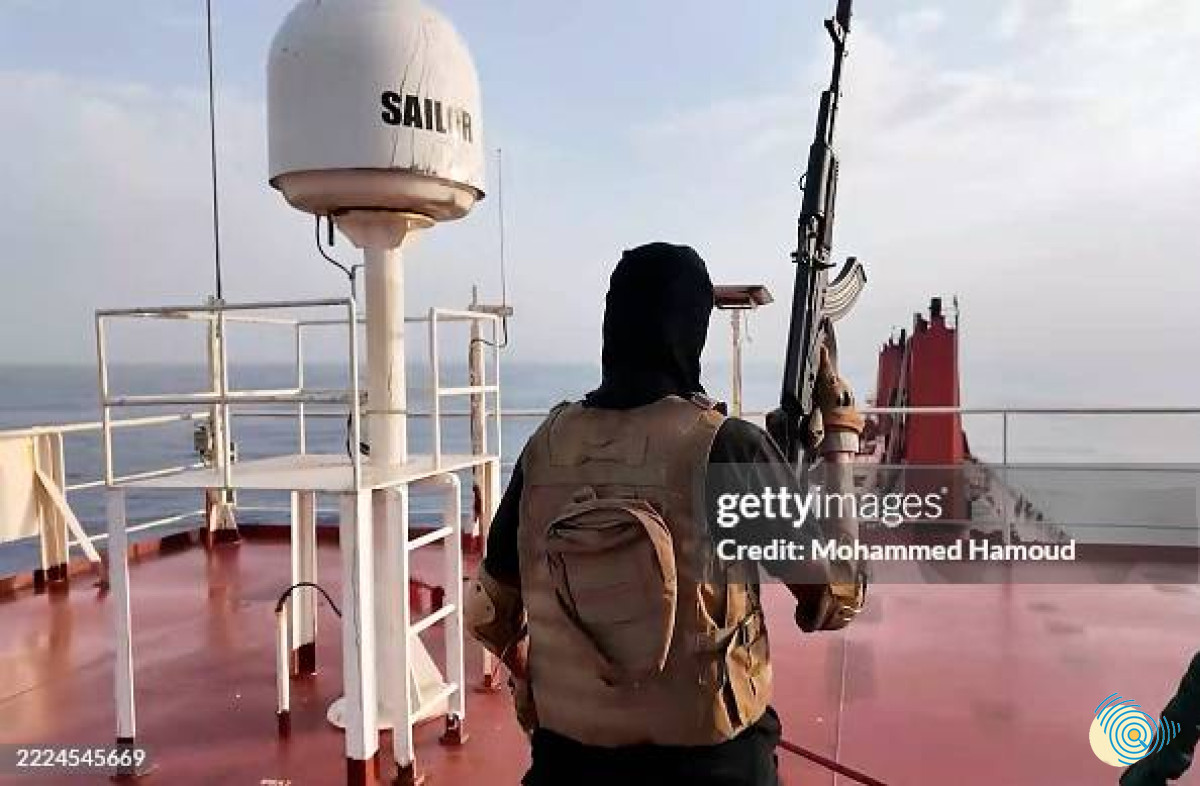
Within this context, the Houthi movement no longer regards the Bab el-Mandeb Strait and the Red Sea merely as geographical spaces falling within its area of control. Rather, it views them as sources of strategic leverage and instruments for reshaping regional power dynamics. The attacks on commercial shipping, the declaration of a maritime blockade against vessels linked to the Kingdom of Saudi Arabia in July 2026, and the proposal to impose fees on transiting vessels are not merely military measures or ad hoc responses. Instead, they reflect an effort to transform one of the world's most important maritime corridors into an instrument of political and economic coercion, thereby raising the cost of excluding the movement from any future arrangements concerning Yemen or the wider region.
The strategic value of this instrument increases as the movement comes under greater pressure at home. More than a decade after seizing Sana'a, the Houthi movement faces mounting economic and social challenges. According to the United Nations Humanitarian Response Plan for 2026, more than 22 million Yemenis require some form of humanitarian assistance, 18.3 million people are experiencing acute food insecurity, and 2.2 million children are suffering from malnutrition. At the same time, international funding has met no more than 20 per cent of identified humanitarian requirements, leaving a financing gap exceeding US$2.1 billion.
Even though this crisis is rooted in the war and the country's institutional fragmentation, the system of governance established by the Houthi movement in the areas under its control has further exacerbated its effects. This has occurred through the expansion of a revenue-extraction economy, the weakening of the private sector, intervention in the banking system, and the diversion of a substantial share of available resources towards military and security priorities rather than investment in development and public services.
From this perspective, the narrative of a "blockade" becomes an integral component of the political economy of the conflict. It serves not merely to explain deteriorating living conditions, but also to reproduce domestic legitimacy and redirect attention away from the structural deficiencies of economic governance towards external factors. In this way, external pressure is transformed into a political resource. At the same time, the economic crisis is presented as a direct consequence of sanctions and international measures, rather than also of the war-driven policies and parallel economic structures that have taken shape over the past decade.
This domestic dimension intersects with a broader regional context shaped by the nature of geopolitical competition in the Middle East. From Iran's perspective, the Red Sea is far more than a maritime corridor for international trade. Rather, it constitutes an extension of the regional deterrence architecture that Tehran has developed through its network of allied armed groups and proxy actors across multiple theatres in the region.
Against the backdrop of mounting political and military pressure, the ability to influence the Bab el-Mandeb Strait assumes increasing strategic significance. It enables Tehran to extend the scope of strategic pressure from the Arabian Gulf and the Strait of Hormuz to the Red Sea, thereby increasing the costs of any potential confrontation while providing it with additional sources of bargaining leverage that extend beyond the Yemeni file to encompass broader questions of regional security and relations with the major international powers.
Within this framework, the Houthi movement has become one of the principal instruments of this regional deterrence architecture. Its relationship with Iran has provided it with military, technological, and political capabilities that have significantly enhanced its ability to influence maritime security. In turn, the movement offers Tehran a relatively low-cost means of keeping one of the world's most strategically important maritime corridors firmly within the calculus of regional deterrence.
Accordingly, the escalation in the Red Sea cannot be understood solely as a reflection of developments within Yemen. Rather, it forms part of a broader strategic dynamic in which the calculations of Yemen's internal conflict intersect with the wider patterns of regional geopolitical competition.
For this reason, episodes of maritime escalation frequently coincide with major strategic turning points, whether during periods of intensified pressure on Iran or when Yemen's political settlement process approaches critical junctures. At such moments, expanding the scope of the crisis serves to reorder the priorities of international actors, shifting their focus away from the imperatives of state-building and economic recovery towards the management of security risks in vital maritime corridors.
The experience of the Red Sea since 2023 demonstrates that military responses, while indispensable for safeguarding maritime navigation, have proved insufficient to eliminate the underlying sources of the threat. Attacks continued despite Operation Prosperity Guardian, the European Union's EUNAVFOR ASPIDES mission, and successive United States and United Kingdom military strikes. At the same time, the crisis compelled major global shipping companies to restructure their logistics networks, increase their reliance on the Cape of Good Hope route, expand investment in alternative ports, and step up spending on maritime security technologies and risk management.
As a result, the crisis has affected far more than the security of maritime navigation. It has reshaped the geography of global trade, prompting investors and transport companies alike to incorporate geopolitical risk into their long-term strategic planning.
Accordingly, safeguarding the Red Sea cannot be achieved through the militarisation of maritime corridors alone, because the sea reflects developments on land far more than it determines them. Every new maritime coalition, every military operation, and every naval escort regime will continue to address the symptoms rather than the underlying causes so long as the Yemeni state remains fragmented, the war economy continues to provide incentives for the perpetuation of conflict, and a non-state actor retains the ability to transform Yemen's strategic location into an instrument of regional bargaining.
Therefore, the starting point for any sustainable strategy to secure the Red Sea must be the restoration of the Yemeni state, empowering the internationally recognised government to re-establish its authority across the country's entire coastline and port infrastructure, reunifying the financial and monetary institutions, dismantling parallel economic structures, resuming oil and gas exports, and reintegrating public resources within a unified national institutional framework.
Likewise, any genuine political settlement must extend beyond securing a ceasefire or establishing a power-sharing arrangement. It must restore the institutions of the state, re-establish the state's monopoly on the legitimate use of force, and place maritime corridors and sovereign resources under unified national governance that is both accountable and subject to the rule of law. Only then can Yemen's strategic location be transformed from a driver of the conflict economy into a catalyst for sustainable development, from an instrument of regional coercion into a bridge for integration between the Gulf and the Horn of Africa, and the security of the Red Sea become the product of a stable state rather than a substitute for one.